A Christian Legend in The Spirit War
The centurion and those with him who were guarding Jesus saw the earthquake and all that had happened. They were terrified, and exclaimed, “Surely he was the Son of God!”
And when the centurion, who stood there in front of Jesus, saw how he died, he said, “Surely this man was the Son of God!”
The Jewish leaders did not want the bodies left on the crosses during the Sabbath. So they asked Pilate to have the legs broken and the bodies taken down…….. But when they came to Jesus and found that he was already dead, they did not break his legs. One of the soldiers pierced Jesus’ side with a spear, bringing a sudden flow of blood and water.
Matthew 27:54, Mark 15:39, John 19:31-34
Ever wonder what a decent, intelligent Roman who got to know Jesus might think of him? Longinus Ciprianus is that character in The Spirit War.
Longinus, though not named in any of the four Gospels, is supposed to be the soldier who drove a spear into crucified Jesus Christ, to make sure he was dead. Legend has it that this soldier suffered from poor vision. Water and blood from the the side of the dead Messiah splashed from the spear wound into his eyes, and restored his sight. This soldier became the first Roman convert to Christ. His name, Longinus, is from Christian folklore.
In The Spirit War, Longinus is a close second to the Blessed Mother in longevity within the Trilogy. We first meet this Roman early in Book 1, as an ambitious young centurion of twenty, wanting to live up to family tradition as a soldier. This youth befriends Jesus’ stepfather. Through Joseph, Longinus meets the Blessed Mother and develops a lifelong platonic love for her. In Books 2 and 3, Longinus rises to the rank of General in the Roman army.
In Healing and Redemption, Book 3 of The Spirit War, Longinus is the Roman Tribune of Northern Palestine when Jesus Christ is crucified.
The Messiah’s only Roman friend tries to stop the crucifixion but fails. A debacle for Rome follows, and Longinus is dishonorably discharged from the army. But by God’s grace, the disgraced soldier lands on his feet and becomes a successful gentleman farmer. We last see Longinus in the epilogue, thirty-one years after the crucifixion. Well into his eighties, the old ex-soldier has a final encounter with the Blessed Mother.
Throughout the Trilogy, Longinus’ exploits are the stuff of legend. Quite appropriate, since we are dealing with an unverifiable character for which there is no documented history. Even so, storied Longinus is a saint of both the Greek Orthodox and Roman Catholic churches.
Longinus has two Roman adversaries – enemies who use different kinds of power against Jesus and him.
Pontius Pilate, the Roman Governor of Palestine, embodies the smug cynicism of the politically powerful. Pilate is a historical figure. He washed his hands in front of the crucifixion mob, to symbolize having no part in unjustly condemning Christ to the cross. He could have shown some spine and stopped it. Instead, Pilate gave in to political expediency, calculating that an innocent life counted less than risking a riot.
Caius Carnicus, a made-up character, embodies the brutal dark side of the Roman empire. Carnicus is Longinus’ bitterest rival within the army. His vileness makes him easy prey for possession by demons, which he welcomes. Carnicus’ alliance with evil spirits gives him superhuman strength for attacking Longinus.
A fun and interesting part of writing a novel, is how characters can grow within a plot and take on a life of their own.
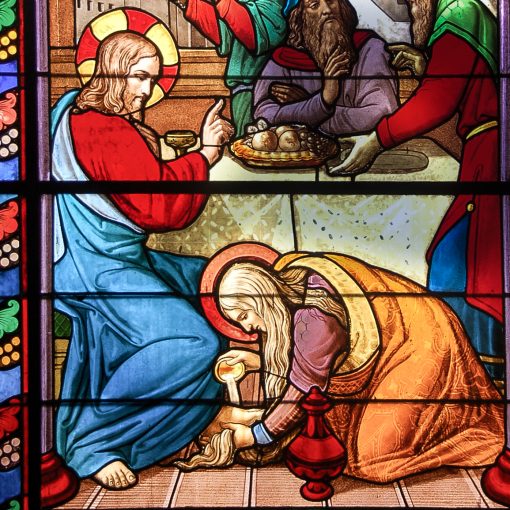
The two personages who did this most in The Spirit War are Mary Magdalene and Longinus. Both are important contributors to the ultimate triumph of Jesus Christ over Death and Satan. Their stories are among the most inspirational in The Spirit War.